 Episeed
A practical guide
How to take literature review notes you can use
A practical literature review note-taking method: separate claims from evidence, keep source locations and turn connected notes into an outline.

Useful literature review notes preserve three things: what a source claims, the evidence behind that claim, and where you can find it again. Keep your interpretation separate from the author's words, then connect notes by the questions they help answer. That makes a review easier to organise around an argument rather than a list of papers.
This guide describes a manual method you can use in Episeed or another note-taking tool. It does not depend on automated summaries.
Start with a question, not a folder of papers
Before a reading session, write one question you want the source to help answer. For example: "How do these studies define a successful learning outcome?"
A question gives you a reason to select a passage. Without one, it is easy to collect long summaries without knowing how they contribute to the review.
Keep the question provisional. If the paper reveals an important distinction, change it or add a new one. The point is to make the reading purposeful, not to force every paper into the same explanation.
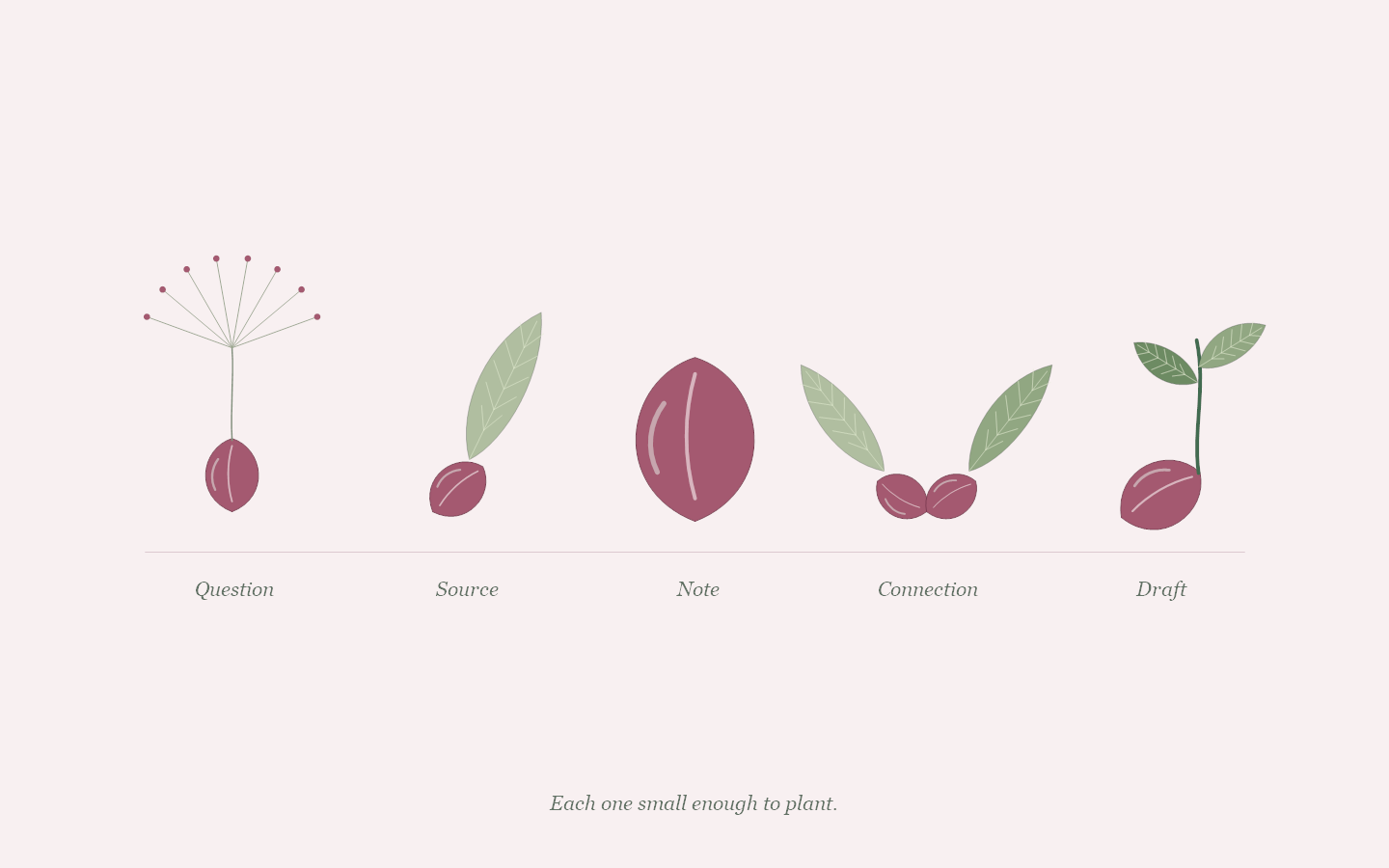
Give each source a short record
At the top of a source note, record enough information to identify and reopen the paper:
- Author, year and title.
- DOI or a stable publisher link, where available.
- The local source filename or its location in your workspace.
- The question that prompted you to read it.
- A short description of the study's setting and method.
Do not treat an imported citation as automatically correct. Check names, title and publication details against the source before submitting a manuscript.
Use a repeatable note template
Here is a compact Markdown template. Copy it into a note and adapt it to your discipline:
## Question
What am I trying to understand?

## Source
Author, year, title, DOI or stable link.

## Claim
The author's argument, written in my own words.

## Evidence and location
Method, result, page, table or section supporting the claim.

## Limits
Scope, assumptions and what the study does not establish.

## My interpretation
What I think follows, and what remains uncertain.

## Connections and next question
Related notes, disagreements and what to read next.
The "location" field matters. A note that says "the intervention helped" is hard to audit. A note that identifies the outcome measure, comparison and relevant table is much easier to revisit.
Keep quotations visibly separate
Mark a direct quotation as a quotation, record its location and do not quietly merge it into your own paraphrase. For a paraphrase, write the point without looking at the original sentence, then return to the source to check that you have not changed its meaning.
If the paper uses a term differently from other authors, preserve that difference. Definitions often explain why apparently similar studies reach different conclusions.
Make a synthesis note across sources
A source note describes one paper. A synthesis note compares several sources around a question. Keep both, because they do different jobs.
For the learning-outcome example, a comparison table might look like this:
| Source | Outcome definition | Evidence location | Limit to check |
|---|---|---|---|
| Paper A | Fill in the actual measure | Page or table | Follow-up period |
| Paper B | Fill in the actual measure | Page or table | Population difference |
| Paper C | Fill in the actual measure | Page or table | Comparison method |
These are template labels, not research findings. Replace every cell with information checked against the real paper.
Then write a few sentences about agreement, disagreement and missing evidence. Link those sentences back to the source notes. In Episeed, connected research notes keep this work close to the rest of the workspace.
Turn uncertainty into a next step
Do not bury unresolved questions in a long paragraph. Make the next action explicit: check a supplementary table, find a definition, read a cited study or compare a conflicting result.
Keep that action connected to the note that raised it. When you return later, you should be able to see both what needs doing and why it matters.
Build an outline from questions
When you have enough notes, group them by the issues your review needs to resolve. A section might explain a definition, compare methods or describe an unresolved disagreement. Avoid making every section simply the name of a different paper.
Before drafting a paragraph, check that its central claim has a source location and that your wording reflects the strength of the evidence. Your notes should make that check faster, not replace it.
When you are ready to write, choose a format that fits your submission requirements. The Markdown versus LaTeX guide explains the tradeoffs.




 Your work, on your desktop